State: Required
Vermont: The Rules Your Auto Policy Must Follow
Vermont makes uninsured and underinsured motorist coverage part of every policy, at limits higher than the liability minimum, and gives drivers one of the longer notice periods before a cancellation or nonrenewal.
By PolicyBrook Editorial Team Updated 5-minute read
Declarations
Vermont- UM/UIM rule
- Required
- Minimum liability
- 25/50/10
- Insurer cancellation notice
- 45 days (15 nonpayment)
- Nonrenewal notice
- 45 days
In brief
A Vermont policy must carry at least $25,000/$50,000/$10,000 of liability coverage, and every policy must include uninsured, underinsured and hit-and-run motorist coverage of at least $50,000/$100,000. After 60 days, an insurer can cancel only for nonpayment, fraud or a policy violation, or a suspended license, with 45 days' notice (15 days for nonpayment). Nonrenewal also needs 45 days' notice. The Vermont Department of Financial Regulation enforces these rules.
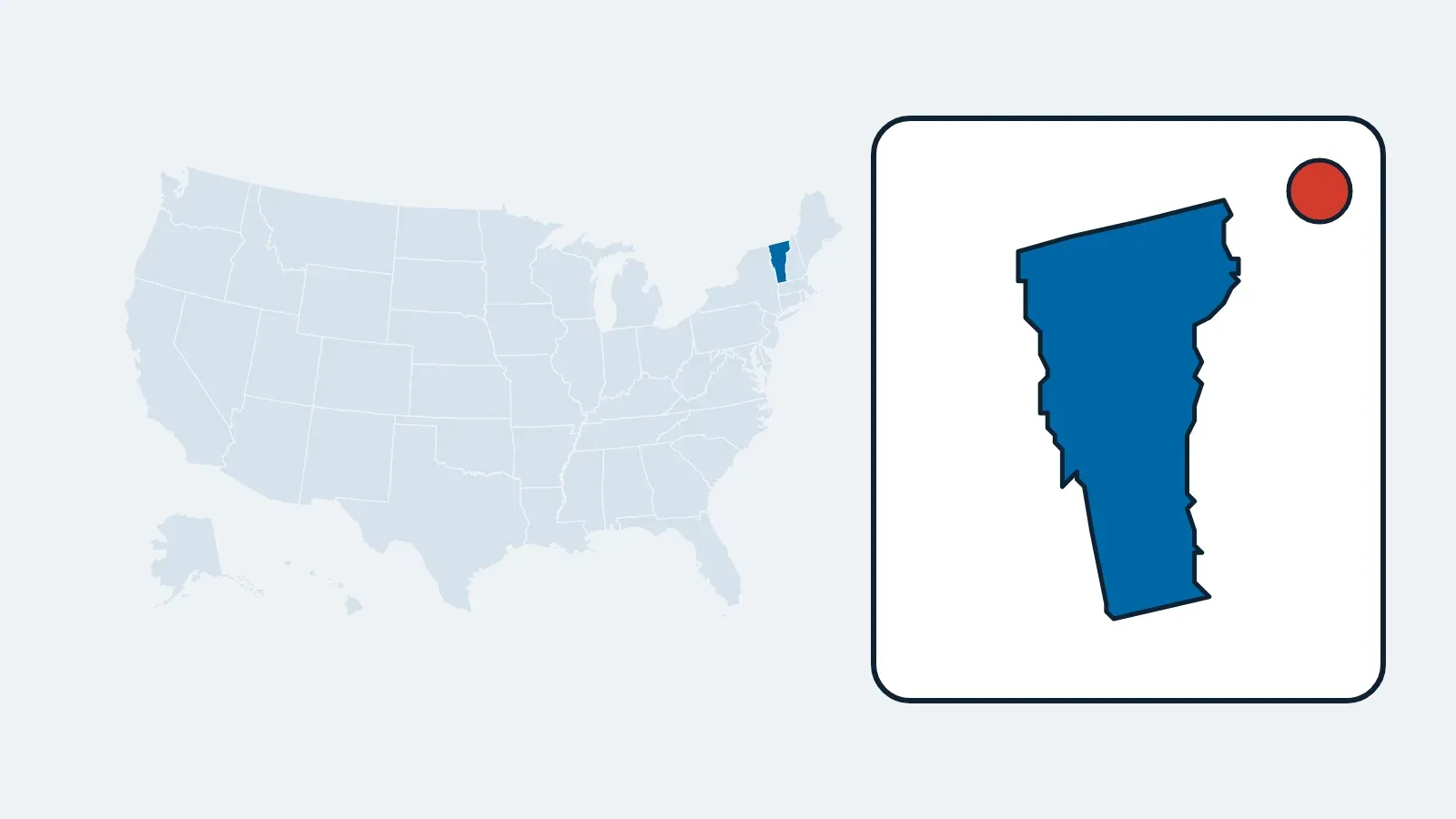
Vermont policy rules
State schedule- UM coverage rule
- Required
- Minimum liability
- 25/50/10
- UM/UIM rule
- Required, 50/100 minimumMatches higher liability limits unless you direct otherwise; includes some property damage
- Insurer cancellation notice
- 45 days; 15 days for nonpaymentAfter 60 days, only for reasons the law lists
- Nonrenewal notice
- 45 daysInsurer must also confirm renewal and premium 45 days ahead
- Regulator
- Vermont Department of Financial Regulation
Minimum limits and proof in Vermont
Title 23, Section 800 of the Vermont Statutes requires liability coverage of at least $25,000 for one person's injuries, $50,000 for all injuries in one crash, and $10,000 for property damage, written as 25/50/10. That property damage floor is low next to the price of many cars on the road; the limits gap worksheet shows what could be left for you to pay.
Section 800 also lets you show proof of coverage on a portable electronic device such as a phone. Using the phone this way does not by itself let an officer look at anything else stored on it.
UM/UIM coverage is required on every policy
Under 23 V.S.A. Section 941, an insurer may not issue a liability policy for a car registered or garaged in Vermont unless it includes uninsured, underinsured and hit-and-run motorist coverage. The statute contains no way to reject it. The Department's consumer guide lists the coverage among the items that are mandatory for all Vermont auto policies.
| Item | Rule under 23 V.S.A. § 941 |
|---|---|
| Minimum limits | $50,000 per person, $100,000 per accident |
| If your liability limits are higher | UM/UIM matches them unless you direct otherwise |
| Property damage from an uninsured driver | Up to $10,000 per claim, $150 deductible, with exceptions |
Notice that the UM floor is twice the liability floor: even a minimum policy pays at least 50/100 when an uninsured or underinsured driver hurts you. See Part C for what the coverage pays and what it excludes.
When a Vermont insurer can cancel your policy
The cancellation rules are in Title 8, Sections 4221 to 4229. They apply to a policy that insures one person or a married couple in the same household, on private passenger cars and light vehicles not used in business, with no more than four cars. During the first 60 days of a new policy the limits do not apply. After that, Section 4223 allows a cancellation only for:
- Nonpayment of the premium.
- Fraud or material misrepresentation, or a violation of the policy's terms.
- Suspension or revocation of the driver's license of the named insured or another operator in the household, during the policy period (or the 180 days before a renewal took effect).
Section 4224 requires the notice to be mailed or delivered at least 45 days before the cancellation takes effect, or at least 15 days when the reason is nonpayment. The reason must be in the notice or go with it. Under Section 4226 the notice goes by certified mail; for nonpayment, a certificate of mailing or a similar tracked first-class method is enough. If the insurer cancels for a reason other than nonpayment, it must also tell you that you may be eligible for the Vermont Automobile Insurance Plan.
Renewal and nonrenewal in Vermont
An insurer that will not renew must mail or deliver notice at least 45 days ahead, under Section 4225. No notice is needed if the insurer offered to renew and you did not pay. The 60-day limits on cancellation reasons do not apply to nonrenewal, so a company can decline to renew for other underwriting reasons as long as it gives the notice.
- Check the date and the reason on the notice. Compare them with the 45-day and 15-day rules above.
- Call the Department of Financial Regulation at 800-964-1784 or use its online complaint form if the notice looks wrong.
- Line up new coverage before the end date. See nonrenewal for what to do in order.
Policyholder questions
Can I reject uninsured motorist coverage in Vermont?
No. Vermont law requires uninsured, underinsured and hit-and-run motorist coverage on every policy, at least 50/100. You can choose limits other than your liability limits only above that floor.
How much notice does a Vermont insurer give before cancelling?
At least 45 days, or 15 days if the reason is nonpayment. After the first 60 days, only nonpayment, fraud or a policy violation, or a suspended or revoked license allow it.
Can I show my Vermont insurance card on my phone?
Yes. Vermont law accepts proof of financial responsibility on a portable electronic device, such as a mobile phone.
Sources
- Vermont Statutes, Title 8, Chapter 113 — Automobile insurance cancellation (§§ 4221–4229)
- Vermont Statutes, Title 23, § 941 — Uninsured, underinsured and hit-and-run motorist coverage
- Vermont Statutes, Title 23, § 800 — Maintenance of financial responsibility
- Vermont Department of Financial Regulation — Consumer's Guide to Auto Insurance (revised May 22, 2019)
Facts on this page were checked against these sources on November 15, 2026. Notice periods come from the statutes; the Department's consumer guide does not list them.
Request policy quotes
Answer six questions about the policy you need. PolicyBrook passes the request to licensed insurance agents and insurers who can quote it; you compare and decide.
- The policy you need. Cars, drivers, coverage and ZIP.
- Your contact details and consent to be contacted.
- A licensed insurance agent or insurer contacts you with a quote. Nothing is bound until you sign and pay.
PolicyBrook is not paid by you. The licensed insurance agents and insurers who contact you set their own prices and terms. How we make money.
Related readings
-

Policy event
Insurer cancellation
After 60 days, only listed reasons; 10 to 60 days' notice by state, and how to appeal.
-
Policy event
Nonrenewal
Notice periods from 15 to 75 days, reasons states bar, and how to ask the regulator for review.
-
Policy part
Uninsured motorists (Part C)
Four kinds of uninsured vehicle, who is insured, limits, 60-day trial right after arbitration, state rules.