State: Reject in writing
Texas: The Rules Your Auto Policy Must Follow
Texas sets the minimum limits, makes insurers include uninsured motorist and PIP coverage unless you turn them down in writing, and limits when a company can cancel or refuse to renew. Here is what that means for your policy.
By PolicyBrook Editorial Team Updated 6-minute read
Declarations
Texas- UM/UIM rule
- Reject in writing
- Minimum liability
- 30/60/25
- Insurer cancellation notice
- 10 days
- Nonrenewal notice
- 60 days
In brief
A Texas policy must carry at least $30,000/$60,000/$25,000 of liability coverage. Uninsured and underinsured motorist coverage and personal injury protection come with every new policy unless the named insured rejects them in writing. After a policy has been in force 60 days, an insurer can cancel only for reasons the law lists, with at least 10 days' mailed notice, and it must give 60 days' notice before it refuses to renew. The Texas Department of Insurance enforces these rules.
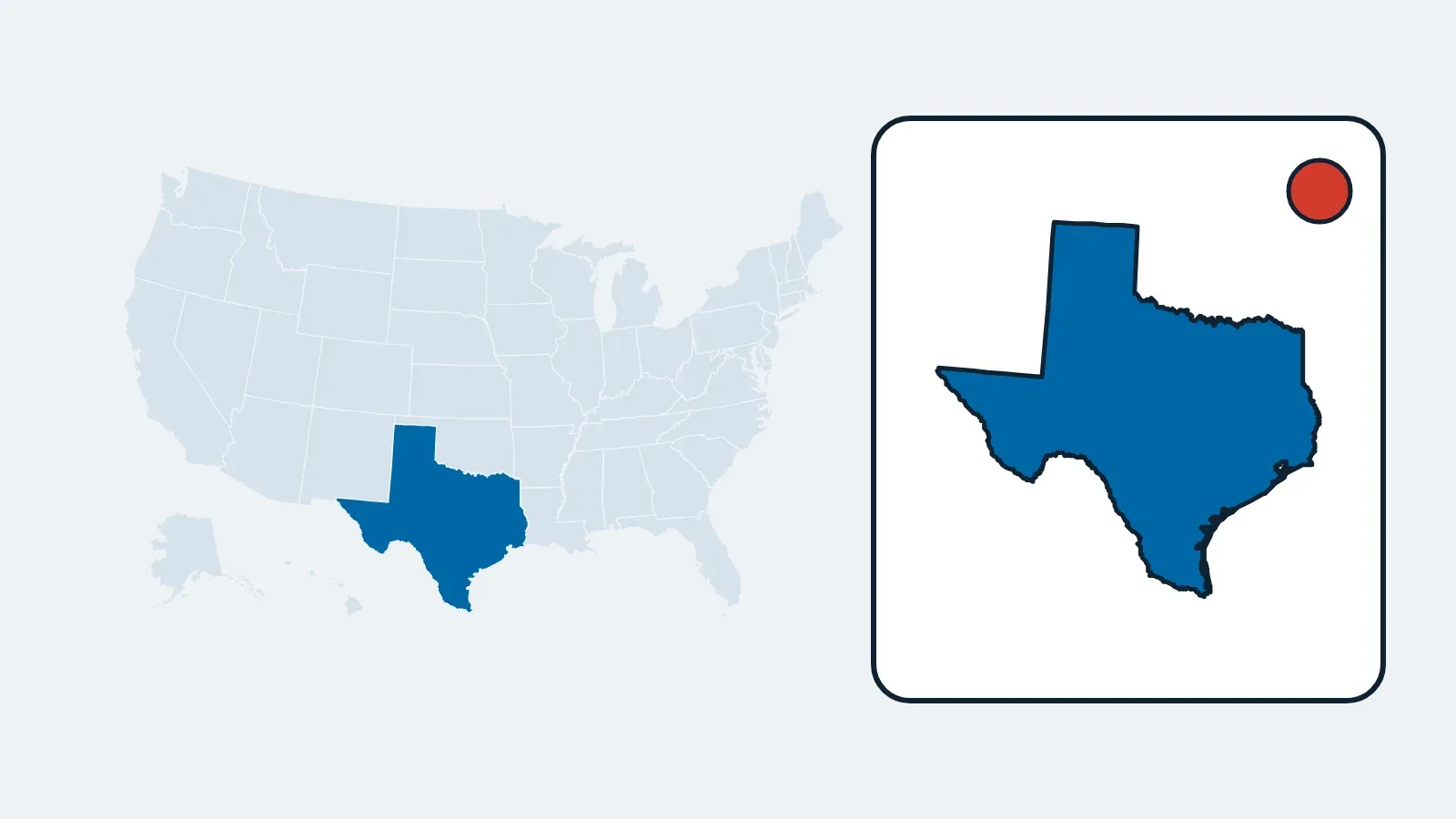
Texas policy rules
State schedule- UM coverage rule
- Reject in writing
- Minimum liability
- 30/60/25
- UM/UIM rule
- Included unless rejected in writingPIP follows the same rule
- Insurer cancellation notice
- 10 daysAfter 60 days in force, only for reasons the law lists
- Nonrenewal notice
- 60 days30 days for policies last bought or renewed before 2024
- Regulator
- Texas Department of Insurance
Minimum limits on a Texas policy
Texas requires liability coverage of at least $30,000 for injuries to one person, $60,000 for all injuries in one accident, and $25,000 for property damage, written as 30/60/25. These are the lowest limits an insurer may print on the declarations page for Part A. The Texas Department of Insurance (TDI) warns that they may be too low when several cars are involved or a newer car is totaled; the limits gap worksheet shows what is left over in a larger crash.
A driver can show proof of this coverage with the insurer's ID card, a copy of the policy, a binder, or an image of the ID card on a phone: Section 601.053 of the Texas Transportation Code lists an image displayed on a wireless device as valid evidence.
UM/UIM and PIP are included unless you reject them in writing
Under Chapter 1952 of the Texas Insurance Code, an insurer must include uninsured and underinsured motorist (UM/UIM) coverage and personal injury protection (PIP) in a new auto policy. The named insured can turn either one down, but only in writing. TDI's consumer guide puts it plainly for PIP: all auto policies in Texas include it, and you must tell the company in writing if you don't want it.
The written rejection carries forward. TDI's consumer bill of rights says insurers do not have to offer the coverages again at renewal, though you may ask for them at any time. If you rejected UM/UIM years ago, your current declarations page will show no limit for it. See Part C and personal injury protection for what each pays.
| Coverage | On a new policy | To remove it |
|---|---|---|
| Uninsured/underinsured motorist | Included | Signed written rejection by the named insured |
| Personal injury protection (PIP) | Included, at least $2,500 per person | Signed written rejection by the named insured |
When a Texas insurer can cancel your policy
During the first 60 days of a new policy, an insurer may cancel for any reason that does not break another law. Once the policy has been in effect 60 days or more, the bill of rights limits cancellation to a short list of reasons, and the notice must be mailed at least 10 days before the cancellation takes effect.
- You do not pay the premium when it is due.
- You file a fraudulent claim.
- TDI determines that keeping the policy would violate the law.
- Your driver's license or vehicle registration is suspended or revoked, unless you agree to exclude yourself as a driver.
- The license or registration of a resident or regular driver is suspended or revoked, unless that person is excluded.
You can cancel at any time. When either side cancels, the insurer must refund the unearned premium within 15 business days of the later of the cancellation date or the day it received the notice. Since September 1, 2026, TDI's rule at 28 TAC §5.7015 requires that refund to be calculated pro rata: short rate penalties are no longer allowed on personal auto policies, though an insurer may keep a minimum retained premium it has filed with TDI. Use the cancellation refund worksheet to estimate it.
Renewal and nonrenewal in Texas
A Texas insurer must keep a policy in force for its first 12 months: if you bought a six-month policy, the company cannot refuse to renew it when the first six months end. After that, it may decline to renew only on the anniversary of the original effective date.
The notice period depends on when the policy was bought or last renewed. TDI says a company must give 60 days' notice for policies bought or renewed in 2024 or later, and 30 days' notice for policies last bought or renewed in 2023 or earlier. If the insurer misses the notice, you can require it to renew. The 60-day rule does not apply when a covered person fails to cooperate in a liability claim.
Where to ask and complain
- Ask the insurer for the reason in writing. Texas insurers must fully explain any decision not to insure, cancel or renew.
- Call TDI's consumer help line at 1-800-252-3439 or file a complaint online at tdi.texas.gov if the reason or the notice does not match the rules above.
- Shop before the end date. A gap in coverage can raise your next premium; see lapse and reinstatement.
Policyholder questions
Can a Texas insurer cancel my car insurance after a claim?
Not mid-term just for a claim once the policy has been in force 60 days: cancellation is limited to nonpayment, fraud, a legal violation found by TDI, or a suspended or revoked license or registration. A claim history can affect renewal instead, within the limits above.
How do I reject uninsured motorist coverage in Texas?
The named insured signs a written rejection, usually a form the insurer provides. Without it, the coverage stays on the policy. Read Part C before you sign.
Can I show my Texas insurance card on my phone?
Yes. The Transportation Code accepts an image of the insurer's proof of insurance shown on a wireless device. Showing the phone does not give the officer permission to look at anything else on it.
Sources
- Texas Department of Insurance — Auto insurance guide (updated December 11, 2025)
- Texas Department of Insurance — Consumer Bill of Rights, Personal Automobile Insurance, 28 TAC §5.9970(b), 2026 version
- Texas Insurance Code, Chapter 1952 — Automobile insurance (UM/UIM and PIP)
- Texas Transportation Code, Section 601.053 — Evidence of financial responsibility
- Texas Department of Insurance — Adopted amendments to 28 TAC §5.7015, unearned premium refunds (effective September 1, 2026)
Facts on this page were checked against these sources on November 15, 2026. Texas changed the nonrenewal notice from 30 to 60 days for policies bought or renewed from 2024 on, and required pro rata refunds from September 1, 2026.
Request policy quotes
Answer six questions about the policy you need. PolicyBrook passes the request to licensed insurance agents and insurers who can quote it; you compare and decide.
- The policy you need. Cars, drivers, coverage and ZIP.
- Your contact details and consent to be contacted.
- A licensed insurance agent or insurer contacts you with a quote. Nothing is bound until you sign and pay.
PolicyBrook is not paid by you. The licensed insurance agents and insurers who contact you set their own prices and terms. How we make money.
Related readings
-

Policy event
Insurer cancellation
After 60 days, only listed reasons; 10 to 60 days' notice by state, and how to appeal.
-
Policy event
Nonrenewal
Notice periods from 15 to 75 days, reasons states bar, and how to ask the regulator for review.
-
Policy part
Uninsured motorists (Part C)
Four kinds of uninsured vehicle, who is insured, limits, 60-day trial right after arbitration, state rules.