State: Required
Oregon: The Rules Your Auto Policy Must Follow
Oregon builds uninsured motorist coverage and personal injury protection into every private passenger policy, sets a 25/50/20 floor, and limits when an insurer can cancel after the first 60 days.
By PolicyBrook Editorial Team Updated 6-minute read
Declarations
Oregon- UM/UIM rule
- Required
- Minimum liability
- 25/50/20
- Insurer cancellation notice
- 30 days (10 nonpayment)
- Nonrenewal notice
- 30 days
In brief
An Oregon policy must carry at least $25,000/$50,000/$20,000 of liability coverage, plus uninsured motorist coverage that includes underinsured coverage, and personal injury protection (PIP) with at least $15,000 for medical expenses. You can lower UM limits in writing, but not below the state minimum. After a policy has been in force 60 days, an insurer can cancel only for nonpayment, fraud or a suspended or revoked license, with 30 days' notice (10 days for nonpayment). Nonrenewal also needs 30 days' notice.
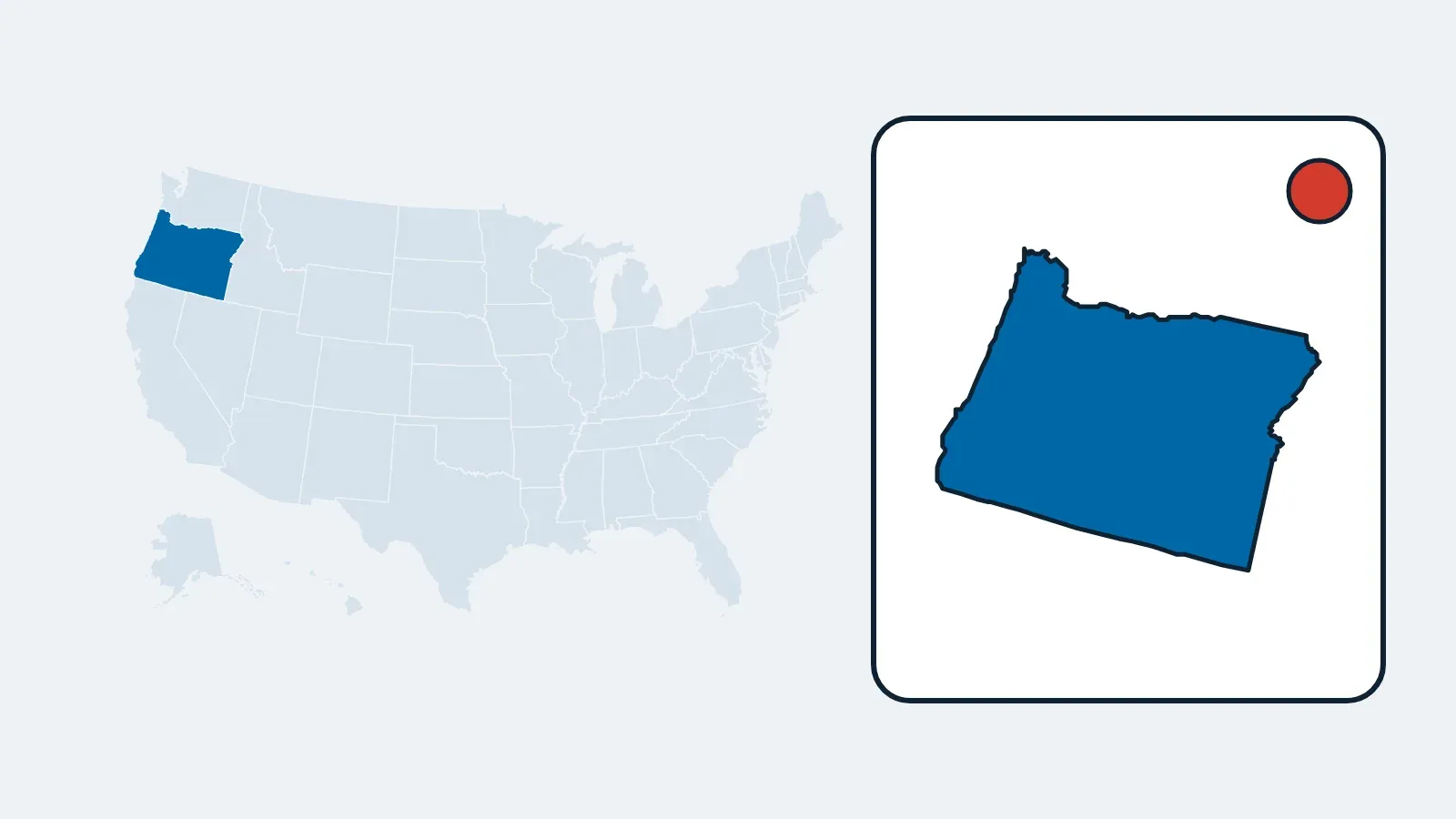
Oregon policy rules
State schedule- UM coverage rule
- Required
- Minimum liability
- 25/50/20
- UM/UIM rule
- Required; UIM included; limits equal liability unless lowered in writingCannot go below 25/50 (ORS 742.502). PIP is also required, $15,000 medical minimum
- Insurer cancellation notice
- 30 days; 10 days for nonpaymentAfter 60 days, only nonpayment, fraud or a suspended license (ORS 742.562)
- Nonrenewal notice
- 30 days45 days if moved to an affiliated insurer's policy (ORS 742.566)
- Regulator
- Oregon Division of Financial Regulation
Minimum limits and proof in Oregon
ORS 806.070 sets the lowest liability limits an Oregon policy may carry: $25,000 for injury or death of one person, $50,000 for two or more people in one accident, and $20,000 for property damage, written as 25/50/20. These are the smallest numbers your declarations page can show for Part A. In a crash with several injured people they can run out fast; the limits gap worksheet shows the shortfall.
ORS 806.011 requires proof of insurance in every vehicle you drive. The same section addresses proof shown on an electronic device: displaying it that way does not give an officer consent to look at anything else on the device.
UM/UIM coverage is part of every policy
ORS 742.502 requires a liability policy issued for delivery in Oregon, or covering a vehicle mainly used or garaged there, to provide uninsured motorist (UM) coverage. The statute has no option to reject it. UM coverage in Oregon must also include underinsurance coverage, which pays when the at-fault driver's liability limits are too low to cover your damages, up to your UM limits.
By default your UM limits match your bodily injury liability limits. A named insured can choose lower UM limits by signing a written election, but the limits cannot drop below the ORS 806.070 amounts for bodily injury. Insurers may also offer UM limits higher than your liability limits. See Part C for how the coverage pays.
Personal injury protection (PIP)
ORS 742.520 requires PIP on every motor vehicle liability policy that covers a private passenger vehicle delivered in Oregon. PIP pays regardless of fault. The minimum benefits are set in ORS 742.524:
| Benefit | Minimum |
|---|---|
| Medical and related expenses | Up to $15,000, for expenses within two years |
| Income loss | 70% of lost income, up to $3,000 a month for 52 weeks, if disabled at least 14 days |
| Essential services | Up to $30 a day for 52 weeks |
| Funeral expenses | Up to $5,000 |
| Child care | $25 a day, up to $750 |
An insurer may offer a deductible of up to $250 on the medical, income and essential services benefits. On your declarations page, PIP shows as its own coverage line with its limit and any deductible you chose. The amounts in the table are minimums the statute sets for every policy, and your own policy wording decides who in your household is covered and how claims are paid. Read more in personal injury protection.
When an Oregon insurer can cancel or refuse to renew
During the first 60 days of a new policy, the reason limits in ORS 742.562 do not apply. Once a policy has been in force 60 days, or at any time on a renewal policy, a cancellation is effective only if it rests on one of these reasons:
- You do not pay the premium.
- Fraud or material misrepresentation.
- A driver's license or driving privileges suspended or revoked during the policy period (or, for a renewal, during the term or the 180 days before it began).
Under ORS 742.564, the insurer must mail or deliver a cancellation notice at least 30 days before it takes effect and state its reasons. For nonpayment, 10 days' notice is enough. The Division of Financial Regulation repeats both periods on its auto insurance page.
To refuse to renew, ORS 742.566 requires at least 30 days' advance notice that states the reasons. If the insurer moves you to an affiliated company's policy in place of a renewal, the notice must go out at least 45 days before the renewal date. See nonrenewal for what to do once you get one.
Where to ask and complain
- Check the notice dates. Count the days from mailing to the end date: 30 for most cancellations and nonrenewals, 10 for nonpayment.
- Compare the stated reason with the three reasons allowed after 60 days.
- Call the Division of Financial Regulation's consumer hotline at 888-877-4894 or file a complaint at dfr.oregon.gov.
- Arrange replacement coverage before the end date. See lapse and reinstatement.
Policyholder questions
Can I turn down uninsured motorist coverage in Oregon?
No. Oregon law requires UM coverage, with underinsurance coverage built in, on every liability policy it applies to. You can only lower the UM limits in writing, and not below 25/50.
Is PIP optional in Oregon?
No. ORS 742.520 requires PIP on private passenger policies, with at least $15,000 for medical expenses and the other minimum benefits in ORS 742.524.
Can an Oregon insurer cancel me midterm after a claim?
Not after the policy has been in force 60 days, unless the reason is nonpayment, fraud or misrepresentation, or a suspended or revoked license. A claim history can matter at renewal instead, with 30 days' notice.
Can I show my insurance card on my phone in Oregon?
ORS 806.011 addresses proof shown on an electronic device and says showing it that way does not let an officer search the rest of the device.
Sources
- Oregon Revised Statutes, Chapter 742 (2025 edition) — ORS 742.502, 742.520, 742.524, 742.562–742.566
- Oregon Revised Statutes, Chapter 806 (2025 edition) — ORS 806.011, 806.070
- Oregon Division of Financial Regulation — Auto insurance
- Oregon Division of Financial Regulation — Consumer advocacy brochure
Facts on this page were checked against these sources on November 15, 2026. Oregon's UM and PIP rules come from ORS chapter 742 in the 2025 edition of the statutes.
Request policy quotes
Answer six questions about the policy you need. PolicyBrook passes the request to licensed insurance agents and insurers who can quote it; you compare and decide.
- The policy you need. Cars, drivers, coverage and ZIP.
- Your contact details and consent to be contacted.
- A licensed insurance agent or insurer contacts you with a quote. Nothing is bound until you sign and pay.
PolicyBrook is not paid by you. The licensed insurance agents and insurers who contact you set their own prices and terms. How we make money.
Related readings
-

Policy event
Insurer cancellation
After 60 days, only listed reasons; 10 to 60 days' notice by state, and how to appeal.
-
Endorsement
Personal injury protection
No-fault injury coverage: $10,000 required in Florida, rejectable in Texas, offered in Washington.
-
Policy part
Uninsured motorists (Part C)
Four kinds of uninsured vehicle, who is insured, limits, 60-day trial right after arbitration, state rules.