State: Reject in writing
Hawaii: The Rules Your Auto Policy Must Follow
Hawaii doubled its minimum liability limits on January 1, 2026, keeps personal injury protection in every policy, and allows an insurer to cancel or refuse to renew only on narrow grounds. Here is what those rules mean for your policy.
By PolicyBrook Editorial Team Updated 5-minute read
Declarations
Hawaii- UM/UIM rule
- Reject in writing
- Minimum liability
- 40/80/20
- Insurer cancellation notice
- 30 days (20 nonpayment)
- Nonrenewal notice
- 30 days
In brief
For policies taking effect on or after January 1, 2026, Hawaii requires liability limits of at least $40,000/$80,000/$20,000, up from 20/40/10, plus $10,000 of personal injury protection. Uninsured and underinsured motorist coverage must be offered, and a named insured can remove it only in writing. After a policy's first 60 days, an insurer may cancel or refuse to renew only on narrow grounds, and it must mail notice 30 days ahead (20 days for nonpayment). The Insurance Division of the Department of Commerce and Consumer Affairs enforces these rules.
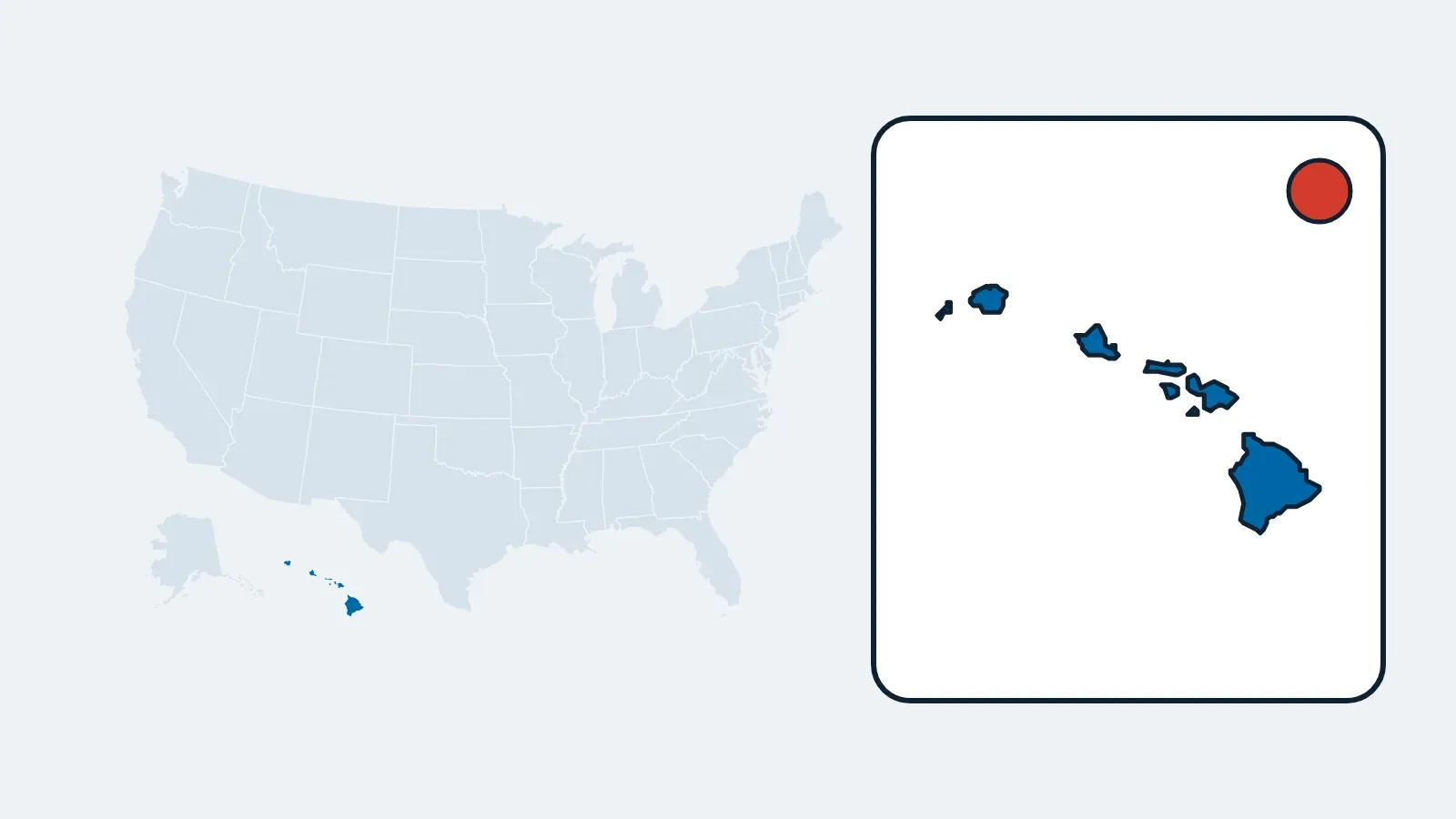
Hawaii policy rules
State schedule- UM coverage rule
- Reject in writing
- Minimum liability
- 40/80/20From January 1, 2026 (was 20/40/10); plus $10,000 PIP
- UM/UIM rule
- Included unless rejected in writingUnderinsured coverage must be offered; rejection needs the insured's signature
- Insurer cancellation notice
- 30 days; 20 days for nonpaymentAfter 60 days, only for unpaid premium or the principal driver's suspended or revoked license
- Nonrenewal notice
- 30 daysNonrenewals capped at 2% of an insurer's policies per territory each year
- Regulator
- Hawaii Insurance Division (Department of Commerce and Consumer Affairs)
Minimum limits and PIP on a Hawaii policy
Act 138 of 2024 raised Hawaii's minimums for new and renewal policies effective on or after January 1, 2026. Under section 431:10C-301 of the Hawaii Revised Statutes, Part A must now provide at least $40,000 for injury to one person, $80,000 for all injuries in one accident, and $20,000 for property damage. The old floor was 20/40/10, so a policy that renewed at the old minimums in 2025 should show higher limits at its 2026 renewal.
Hawaii also keeps its no-fault coverage. Personal injury protection (PIP) pays reasonable and necessary treatment for injuries from a crash, regardless of fault, up to $10,000 per person under § 431:10C-103.5; insurers may sell more. The Insurance Division reminds drivers to keep proof of coverage with them when they drive. See personal injury protection for how the coverage appears on the declarations page, and the limits gap worksheet to test the new minimums against a larger crash.
UM and UIM coverage are offered and need a written rejection
Section 431:10C-301 requires uninsured motorist coverage on a policy for a car registered or principally garaged in Hawaii, with bodily injury limits tied to the minimums above, unless a named insured rejects it in writing. Underinsured motorist coverage follows a similar rule: the offer must be easy to see, must show the premium next to it, and can be declined only by the insured's signature.
The insurer must make the offer when you first apply. Once you have answered it in writing, the company need not repeat it at renewal or on a replacement policy, and a signed rejection is presumed to reflect your choice. Read Part C before you sign.
| Coverage | Rule | Statute |
|---|---|---|
| Liability (Part A) | Required, at least 40/80/20 from 2026 | HRS § 431:10C-301 |
| Personal injury protection | Required, $10,000 per person | HRS § 431:10C-103.5 |
| Uninsured motorist | Included unless rejected in writing | HRS § 431:10C-301 |
| Underinsured motorist | Offered; signed written rejection | HRS § 431:10C-301 |
When a Hawaii insurer can cancel or refuse to renew
Under § 431:10C-111, an insurer may cancel or refuse to renew a motor vehicle policy only when:
- The principal driver's license is suspended or revoked.
- The premium is still unpaid after a reasonable demand.
- The policy has been in effect 60 days or less, and the reason is not one the law forbids.
- For a nonrenewal, the reason falls within the yearly allowance in § 431:10C-111.5, which caps an insurer's nonrenewals and conditional renewals at 2 percent of its policies in each rating territory.
A company may also decline to renew if it stops writing new policies of any kind in Hawaii, or if the Insurance Commissioner finds that writing more would harm its finances. It may never refuse to continue a policy only because of race, creed, ethnic extraction, age, sex, driving experience, marital status, residence, a disability, or the coverages and deductibles you chose. If you raise one of these, the insurer has to prove it did not rely on it.
Under § 431:10C-112, the notice must be mailed at least 30 days before a cancellation or nonrenewal takes effect, or at least 20 days before a cancellation for nonpayment, and the insurer needs a Postal Service certificate of mailing. If the company offered to renew at least 30 days before the term ends and you do not accept, the policy simply lapses at expiration.
Refunds after a cancellation
When a Hawaii policy is canceled, the insurer must refund any prepaid premium for the unearned period within 15 days after the cancellation and the return of your insurance ID card, or your signed affidavit that the card was lost or stolen. Send the card back promptly so the 15 days can start. The cancellation refund worksheet helps you estimate the amount.
Where to ask and complain
- Check the notice. Confirm the mailing date, the effective date and whether the reason is one the law allows.
- Ask the insurer or agent to explain it in writing.
- Contact the Hawaii Insurance Division at 1-844-808-DCCA (3222), at 335 Merchant Street, Room 213, Honolulu, or through cca.hawaii.gov/ins.
- Keep coverage in force. Hawaii requires proof of insurance whenever you drive; see lapse and reinstatement.
Policyholder questions
When did Hawaii's 40/80/20 minimum start?
It applies to new and renewal personal auto policies with effective dates on or after January 1, 2026. Before that, the minimum was 20/40/10.
Can a Hawaii insurer cancel my policy after a claim?
After the first 60 days, not for a claim alone. Cancellation is limited to a suspended or revoked license of the principal driver or unpaid premium after a reasonable demand.
How do I reject uninsured motorist coverage in Hawaii?
A named insured rejects it in writing; for underinsured coverage, the insured signs the rejection. See Part C before you decide.
Sources
- Hawaii Revised Statutes § 431:10C-301 — Required motor vehicle policy coverage
- Hawaii Revised Statutes § 431:10C-111 — Cancellation and nonrenewal
- Hawaii Revised Statutes § 431:10C-112 — Notice of cancellation or nonrenewal
- Hawaii Revised Statutes § 431:10C-111.5 — Limits on nonrenewals
- Hawaii Revised Statutes § 431:10C-103.5 — Personal injury protection benefits
- Session Laws of Hawaii 2024, Act 138 — Higher minimum limits from January 1, 2026
- Hawaii Insurance Division — Auto minimum limits FAQs
Facts on this page were checked against these sources on November 15, 2026. Hawaii's minimum liability limits rose from 20/40/10 to 40/80/20 for policies effective on or after January 1, 2026.
Request policy quotes
Answer six questions about the policy you need. PolicyBrook passes the request to licensed insurance agents and insurers who can quote it; you compare and decide.
- The policy you need. Cars, drivers, coverage and ZIP.
- Your contact details and consent to be contacted.
- A licensed insurance agent or insurer contacts you with a quote. Nothing is bound until you sign and pay.
PolicyBrook is not paid by you. The licensed insurance agents and insurers who contact you set their own prices and terms. How we make money.
Related readings
-

Endorsement
Personal injury protection
No-fault injury coverage: $10,000 required in Florida, rejectable in Texas, offered in Washington.
-
Policy event
Nonrenewal
Notice periods from 15 to 75 days, reasons states bar, and how to ask the regulator for review.
-
Policy part
Uninsured motorists (Part C)
Four kinds of uninsured vehicle, who is insured, limits, 60-day trial right after arbitration, state rules.