State: Required
Connecticut: The Rules Your Auto Policy Must Follow
Connecticut requires uninsured and underinsured motorist coverage on every policy, requires 45 days' notice for most cancellations, and allows only two reasons to cancel after 60 days. Here is how those rules shape your policy.
By PolicyBrook Editorial Team Updated 5-minute read
Declarations
Connecticut- UM/UIM rule
- Required
- Minimum liability
- 25/50/25
- Insurer cancellation notice
- 45 days (10-15 nonpayment)
- Nonrenewal notice
- 60 days
In brief
A Connecticut policy must carry at least $25,000/$50,000/$25,000 of liability coverage and uninsured and underinsured motorist coverage, which you can lower by signed form but not drop below the minimum. After 60 days, an insurer can cancel only for unpaid premium or a revoked license or registration. Cancellation notice is 45 days, or 10 to 15 days for unpaid premium, and a nonrenewal notice must arrive 60 days ahead. The Connecticut Insurance Department oversees these rules.
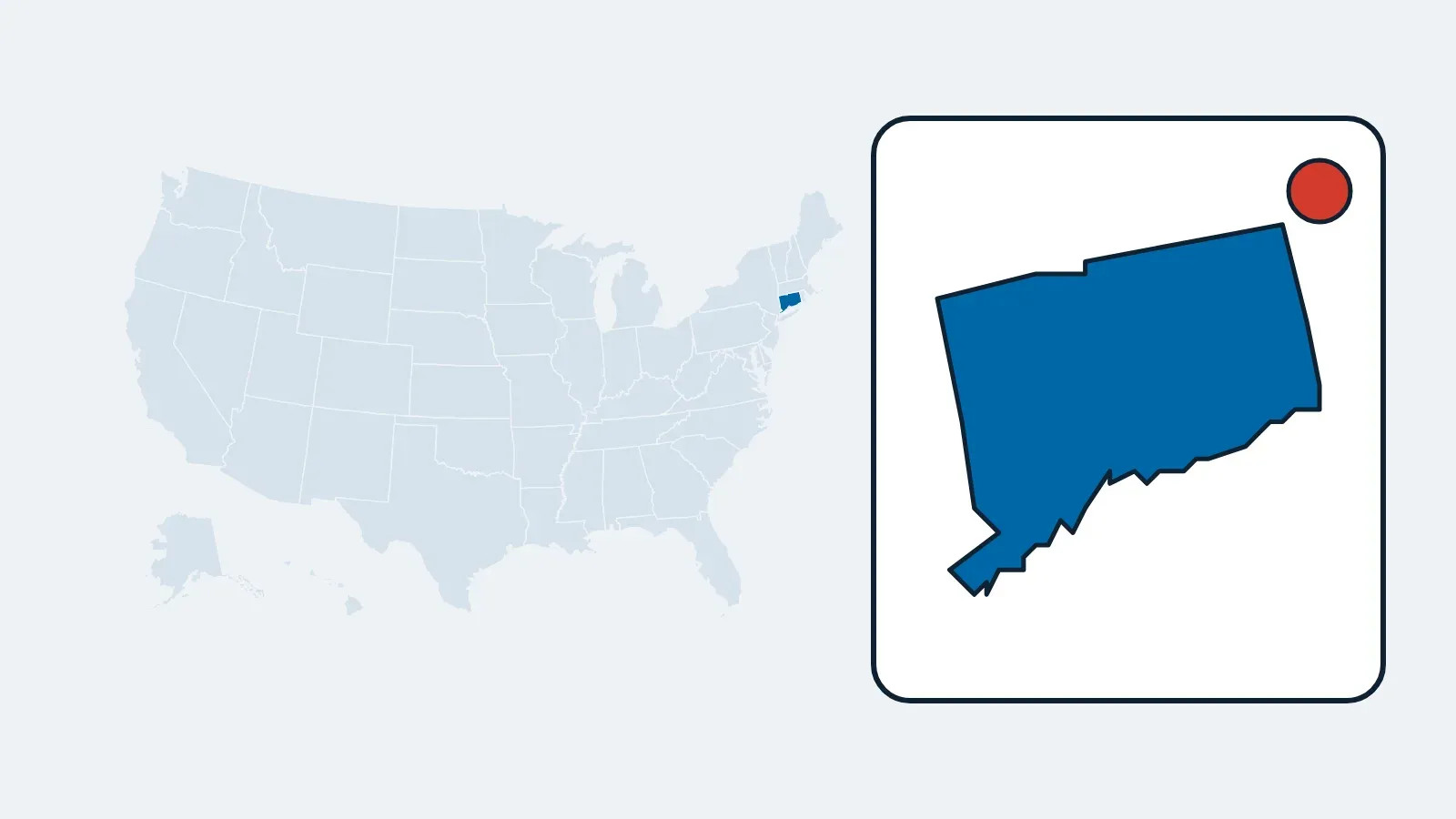
Connecticut policy rules
State schedule- UM coverage rule
- Required
- Minimum liability
- 25/50/25
- UM/UIM rule
- Required, at least 25/50; equal to liability limits unless lowered by signed form§38a-336 allows lower limits by informed consent form, with no provision for full rejection
- Insurer cancellation notice
- 45 days; 10 days for nonpayment; 15 days for an unpaid first premium on a new policyAfter 60 days in force, only for nonpayment or a revoked license or registration (§38a-342)
- Nonrenewal notice
- 60 daysUnder the general nonrenewal statute, §38a-323; the reason must be stated
- Regulator
- Connecticut Insurance Department
Minimum limits on a Connecticut policy
Section 14-112(a) of the Connecticut General Statutes sets the floor at $25,000 for injury or death of one person, $50,000 for injuries to more than one person in a single accident, and $25,000 for property damage. These figures also set the lowest uninsured motorist limits you can choose.
A 25/50/25 policy can run out quickly when several people are hurt. The limits gap worksheet shows what would be left unpaid in a sample crash.
Uninsured and underinsured motorist coverage is required
Section 38a-336 requires every auto liability policy to include uninsured and underinsured motorist (UM/UIM) coverage. The statute lets a named insured lower the amount but does not provide a way to remove the coverage entirely. By default, the UM/UIM limits equal the bodily injury liability limits you buy, and insurers must offer limits up to twice those liability limits.
A request for lower limits is valid only if a named insured signs an informed consent form. That form must explain the coverage in language the Insurance Commissioner approves, list the insurer's options with the premium for each, and carry a warning in a 12-point heading. Your choice then applies to every renewal and replacement policy until a named insured changes it in writing.
| Choice | Allowed? | How |
|---|---|---|
| Same limits as your liability coverage | Yes, the default | No form needed |
| Higher limits, up to twice your liability limits | Insurer must offer them | Ask and pay the premium |
| Lower limits, down to 25/50 | Yes | Signed informed consent form |
| No UM/UIM at all | Not provided for in the statute | None |
See Part C for how the coverage pays.
When a Connecticut insurer can cancel your policy
Section 38a-342 limits cancellation once a policy has been in effect 60 days. From then on, the only reasons are:
- You do not pay the premium.
- The driver's license or registration of the named insured, a household resident or a regular driver is revoked during the policy period.
Section 38a-343 sets the notice. In most cases it must go out at least 45 days before the cancellation date. For nonpayment, it is 15 days when the first premium on a new policy is unpaid and 10 days for any other missed payment. During the first 60 days, a 10-day notice also applies to a material misrepresentation. The insurer must send the notice by registered or certified mail or with a certificate of mailing, or electronically if you both agreed to that, and it must state the reason. The notice also has to carry a warning, in a form approved by the motor vehicle and insurance commissioners, about what a lapse means for your registration. If a lender or lessor has a legal interest in the car, the insurer must notify it in writing as well.
If you cancel a policy yourself before it expires, Section 38a-343(e) caps the insurer's total fees and charges for doing so at $100. Estimate the unused premium with the cancellation refund worksheet.
Renewal and nonrenewal in Connecticut
The auto cancellation section does not cover nonrenewal. Connecticut's general nonrenewal statute, Section 38a-323, requires at least 60 days' advance notice of an intent not to renew, sent by the same mailing methods and stating the reason. The Insurance Department's bulletins on cancellation and nonrenewal list this section among the rules for personal lines.
Where to ask and complain
- Read the stated reason. A Connecticut cancellation or nonrenewal notice must give one.
- Contact the Connecticut Insurance Department at portal.ct.gov/cid if the reason or the timing does not match the rules above.
- Keep coverage in force. The notice also warns about registration consequences of a lapse; see lapse and reinstatement.
Policyholder questions
Can I drop uninsured motorist coverage in Connecticut?
Not entirely. You can lower it to the 25/50 minimum by signing an informed consent form, but every auto liability policy must include it. See Part C.
How much notice must a Connecticut insurer give before cancelling?
At least 45 days in most cases. For unpaid premium it is 15 days on a new policy's first premium and 10 days for other missed payments.
Can a Connecticut insurer cancel my policy after an accident?
Not midterm for the accident alone once the policy has run 60 days. After that, the only grounds are unpaid premium or a revoked license or registration.
Sources
- Conn. Gen. Stat. §38a-336 — Uninsured and underinsured motorist coverage (via FindLaw)
- Conn. Gen. Stat. §38a-342 — Grounds for cancellation of automobile policies (via FindLaw)
- Conn. Gen. Stat. §38a-343 — Notice of cancellation (via FindLaw)
- Conn. Gen. Stat. §38a-323 — Notice of nonrenewal (via FindLaw)
- Conn. Gen. Stat. §14-112 — Minimum limits (via FindLaw)
- Connecticut Insurance Department — Bulletin PC-42-09, Cancellation and nonrenewal of personal and commercial policies (August 7, 2009)
Facts on this page were checked against these sources on November 15, 2026. Connecticut's UM/UIM coverage can be reduced by signed form but the statute gives no way to reject it outright.
Request policy quotes
Answer six questions about the policy you need. PolicyBrook passes the request to licensed insurance agents and insurers who can quote it; you compare and decide.
- The policy you need. Cars, drivers, coverage and ZIP.
- Your contact details and consent to be contacted.
- A licensed insurance agent or insurer contacts you with a quote. Nothing is bound until you sign and pay.
PolicyBrook is not paid by you. The licensed insurance agents and insurers who contact you set their own prices and terms. How we make money.
Related readings
-

Policy event
Insurer cancellation
After 60 days, only listed reasons; 10 to 60 days' notice by state, and how to appeal.
-
Policy event
Nonrenewal
Notice periods from 15 to 75 days, reasons states bar, and how to ask the regulator for review.
-
Policy part
Uninsured motorists (Part C)
Four kinds of uninsured vehicle, who is insured, limits, 60-day trial right after arbitration, state rules.